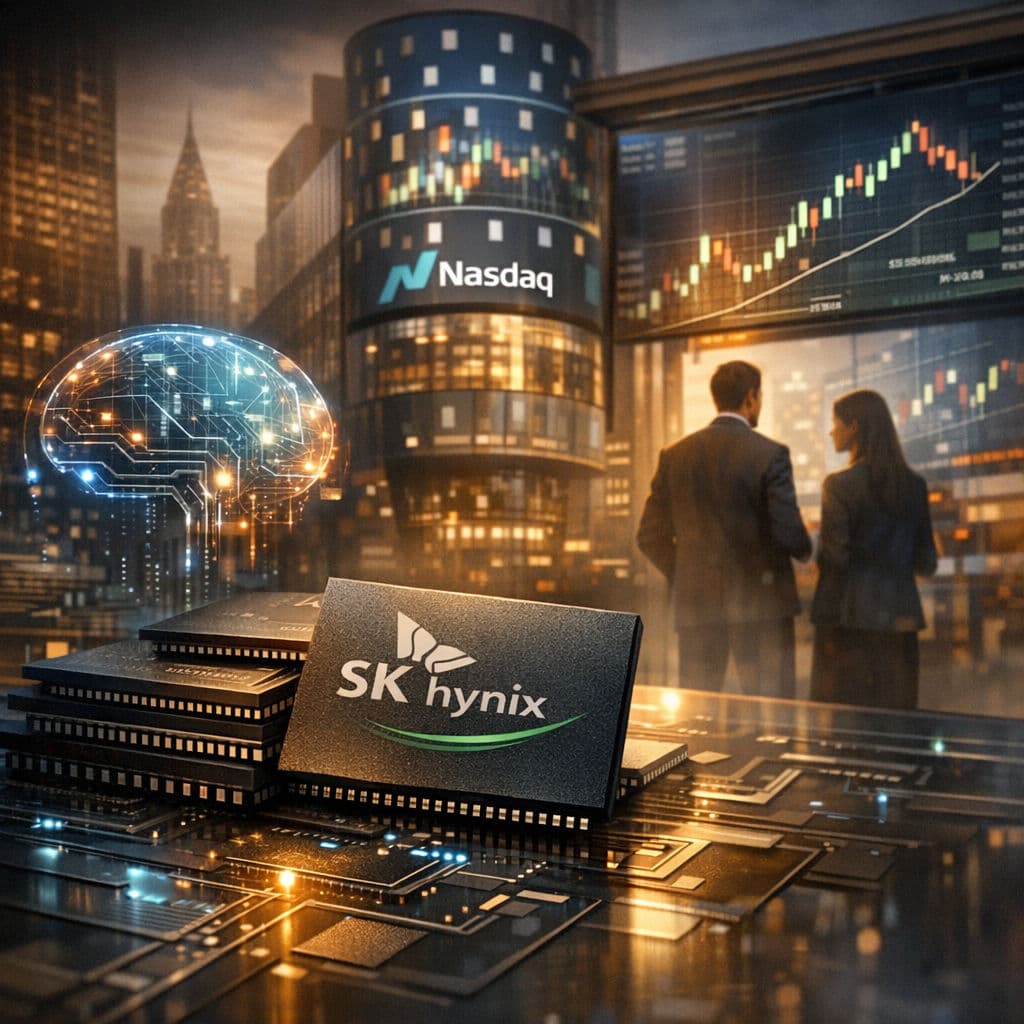
SK Hynix’s reported US$26.5 billion Nasdaq listing has become a defining signal in the 2026 AI capital cycle: public investors are no longer backing only model developers and platform narratives. They are also backing the physical supply chain, especially high-bandwidth memory, advanced packaging, and the manufacturing footprint needed to keep AI data centre buildouts moving.
According to Tech Wire Asia, the South Korean chipmaker priced its American depositary receipts at US$149 each under the ticker SKHY, with trading set to begin on July 10. The same report says the deal surpassed Alibaba’s US$21.8 billion 2014 IPO to become the largest US listing by a foreign company. Tech Wire Asia also reported that only SpaceX’s June share sale was larger overall, though that ranking should be treated as attributed market framing rather than independently confirmed across the full source set.
For technology leaders, the more important point is not the record itself. It is what the money is meant to build.
SK Hynix Is Raising US Capital to Expand Korean AI Memory Capacity
Tech Wire Asia reports that SK Hynix said the proceeds will fund a new semiconductor fabrication plant, an advanced chip packaging facility in South Korea, and 11.9 trillion won in extreme ultraviolet lithography equipment scheduled for installation by the end of next year.
That matters because the transaction ties US capital markets directly to Korean AI infrastructure expansion. This was not presented as a liquidity event for insiders. It was presented as a capacity buildout aimed at one of the hardest constraints in the AI stack: memory supply that can keep pace with accelerator demand.
For readers tracking Enterprise AI, the implication is straightforward. AI infrastructure availability is shaped not only by GPU roadmaps and cloud leases, but by the memory, packaging, and equipment layers that determine whether those systems can actually ship at scale.
HBM Has Moved From Component Category to Strategic Control Point
According to Tech Wire Asia, SK Hynix holds an estimated 50% to 55% share of the high-bandwidth memory market. It also names Nvidia and Alphabet’s Google among the company’s largest customers. In practical terms, that places SK Hynix near the center of the modern AI compute stack, because HBM is the memory architecture closely associated with advanced AI accelerators and large training clusters.
KAIST electrical engineering professor Yoo Hoi-jun, quoted by Tech Wire Asia, described SK Hynix as “indispensable” as long as demand for GPUs and AI data centres holds. Even allowing for the single-source nature of that characterization, it captures why the market appears willing to finance manufacturing expansion at record scale.
This is also why the deal should interest executives beyond the semiconductor sector. Enterprises buying AI capacity indirectly depend on HBM availability, whether they procure through hyperscalers, managed infrastructure providers, or GPU system vendors. Memory concentration can influence server lead times, cluster pricing, and the pace at which new AI services reach production.
Investor Demand Shows AI Infrastructure Is Now a First-Class Equity Theme
Tech Wire Asia reports that the offering was more than seven times oversubscribed, citing Reuters and people familiar with the matter. It also says cornerstone investors including Baillie Gifford Overseas, funds managed by Coatue Management, and Situational Awareness Partners collectively indicated interest in up to US$7 billion of the ADRs.
Situational Awareness Partners is identified by Tech Wire Asia as an AI infrastructure fund founded by former OpenAI researcher Leopold Aschenbrenner. That detail is notable because it suggests sophisticated AI-focused capital is not only chasing frontier Models, but also the supply-chain layers that determine whether those models can be trained and deployed economically.
This broadens the AI investing narrative. The market is no longer valuing only applications, foundation model developers, and cloud platforms. It is increasingly valuing bottleneck suppliers whose products are prerequisite inputs for those higher-level businesses.
The Deal Fits a Wider 2026 IPO Pattern Across the AI Stack
The broader market context reinforces that reading. TechHQ reported in June that SpaceX’s share sale was the largest listing ever attempted, and that OpenAI and Anthropic had both moved into confidential IPO filing processes. In TechHQ’s framing, these listings collectively represented a market trying to price both massive AI growth expectations and significant execution risk.
SK Hynix extends that pattern into the hardware substrate. SpaceX, in TechHQ’s account, represented AI infrastructure at hyperscale data centre level. OpenAI and Anthropic represented frontier model companies. SK Hynix represents a lower-layer choke point: the memory systems that advanced accelerators require.
For decision-makers, this is a useful lens. The 2026 AI market is not being financed as a single category. It is being financed as an interdependent stack: compute clusters, foundation models, and semiconductor inputs. That has consequences for vendor strategy, procurement timing, and capital allocation.
Why This Matters to Technology decision-makers
First, supply risk in AI should no longer be framed as “GPU access” alone. Memory and packaging are now visible constraints with their own financing cycles and expansion timelines.
Second, concentration risk remains high. If one supplier controls roughly half of the HBM market, disruptions or delays can ripple across cloud deployments, AI appliance rollouts, and enterprise model training plans.
Third, new capital does not equal immediate supply relief. Tech Wire Asia reports that major EUV tool installations are scheduled through the end of next year. That suggests capacity expansion may lag investor enthusiasm, leaving near-term tightness in place even if longer-term output improves.
Fourth, US investors now have a direct public-market vehicle for a strategic AI memory supplier. That may shift attention and capital toward infrastructure names with hard supply advantages, not just software or Startups pitching AI exposure.
Finally, leaders should use this moment to revisit second-source planning, cloud-versus-on-prem timing, and budget assumptions for AI systems whose economics depend on constrained hardware layers. In some organizations, the operational bottleneck may sit well below the application tier.
What Still Requires Caution
Several important claims in the current reporting are best handled carefully.
The reported oversubscription level of more than seven times comes via Tech Wire Asia citing Reuters and unnamed people familiar with the matter, and is not independently corroborated elsewhere in the provided source set.
Likewise, Tech Wire Asia reports that SK Hynix’s Seoul-listed stock had risen more than 200% and that its market value had passed US$1 trillion, but no second provided source confirms that valuation point.
And while Tech Wire Asia says only SpaceX’s June IPO ranks above SK Hynix globally by share-sale size, the cross-source evidence supports SpaceX as larger without independently validating SK Hynix’s exact global ranking. For that reason, the second-place framing should remain attributed.
Those caveats do not change the central conclusion. Even under conservative reading, the transaction indicates that AI memory supply has become a strategic capital-markets theme.
The Operational Read-Through for 2026 and Beyond
The strongest read-through is that the AI economy’s next bottlenecks may be less about demand formation and more about industrial execution. Building fabs, scaling advanced packaging, and installing EUV tools are slower, more capital-intensive processes than launching a new software feature or API.
That distinction matters across adjacent sectors, including Developer Tools and enterprise software. Even if code generation, orchestration, and AI agents continue to improve quickly, infrastructure cost and availability still shape deployment velocity. In other words, software-side acceleration does not eliminate hardware-side gating factors.
SK Hynix’s reported Nasdaq debut therefore looks less like a one-off record and more like evidence that financial markets are beginning to price the true physical constraints of AI growth. For CIOs, CTOs, procurement leaders, and infrastructure investors, that is the more durable signal.
Sources and Methodology
This article was produced in multi-source mode using a de-duplicated fact set and explicit discrepancy handling. Primary reporting came from Tech Wire Asia on SK Hynix’s listing details and use of proceeds, with market context from TechHQ on 2026 AI IPO activity involving SpaceX, OpenAI, and Anthropic. Claims not independently corroborated across the source set are attributed directly to the reporting outlet rather than presented as fully cross-verified fact.