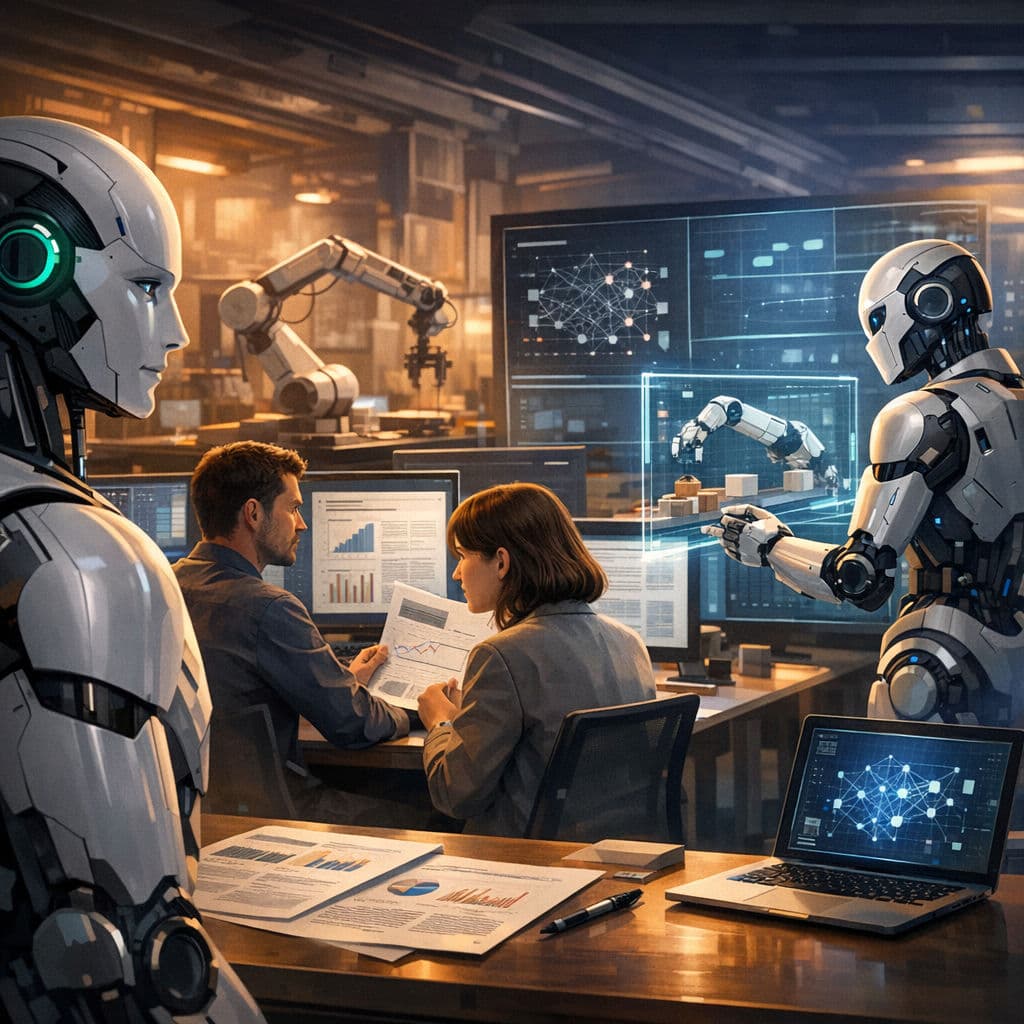

Learning to lead in a hybrid human-AI enterprise centers on how organizations manage AI agents that can coordinate complex tasks across systems, according to the source article in Models & Research. The article says adoption of AI agents looks set to surge by as much as 300% in the next two years, while leadership teams assess the implications of a hybrid human-AI workforce.
From manual automation to AI agents
The source article distinguishes current enterprise automation from AI agents by describing existing automation as reliant on manual input. By contrast, it says AI agents can autonomously coordinate complex tasks and interact with multiple tools and environments across systems.
That difference matters because conventional automation typically follows predefined instructions or triggers, while agent-based systems are described as operating across a broader sequence of actions. In enterprise settings, cross-system operation may depend on integrations, permissions, and oversight controls. Readers tracking related enterprise deployment issues may also find Rising AI costs prompt tighter review of marketing workflows useful for context on implementation scrutiny.
What the projected adoption increase suggests
The source states that adoption of AI agents could rise by as much as 300% over the next two years. The extractor notes do not provide a baseline, sector split, or methodology for that projection, so those details cannot be confirmed here.
Even so, the projection indicates that leadership teams are considering AI agents as a larger part of enterprise operations. If adoption rises at that pace, organizations may need to make decisions more quickly about governance, system access, and performance monitoring. This topic also sits within broader AI Business & Startups coverage, where enterprise deployment trends often intersect with procurement and operations planning.
Technical capabilities cited by the source
The source identifies two core capabilities:
- AI agents can autonomously coordinate complex tasks.
- AI agents can interact with multiple tools and environments across systems.
These capabilities align with wider industry discussion of agentic systems and tool use. For reference, Anthropic's Model Context Protocol documentation describes a standard approach for connecting AI systems to tools and data sources, while the NIST AI Risk Management Framework outlines governance considerations for AI deployment. The concept of language-model agents using tools has also been discussed in research such as Toolformer.
Leadership implications in a hybrid workforce
According to the source, leadership teams are considering the implications of a hybrid human-AI workforce. Based on the verified notes, that means organizations are evaluating how work may be divided when employees and AI systems both contribute to operations.
The source supports several practical questions for management:
- which tasks should remain human-led;
- which tasks can be delegated to AI agents;
- how autonomous actions should be supervised;
- how work across multiple systems should be governed.
Because the source emphasizes leadership, the issue extends beyond software capability alone. It also concerns accountability, team structure, and operational oversight when AI systems move beyond manually directed automation.
What can be stated from the source
The source article supports a narrower conclusion than some of the original draft's broader inferences. Verified points are limited to the following:
- leadership teams are considering a hybrid human-AI workforce;
- existing enterprise automation relies on manual input;
- AI agents can autonomously coordinate complex tasks;
- AI agents can interact with multiple tools and environments across systems;
- adoption of AI agents is projected by the source to increase by as much as 300% in the next two years.
For readers interested in the policy side of AI deployment and implementation constraints, EFF Says California A.B. 412 Would Be Difficult to Implement for AI Developers offers related context on governance and compliance questions.
Overall, the source presents AI agents as a shift from manual-input automation toward more autonomous enterprise software, with leadership teams weighing the technical and managerial implications of that change.