
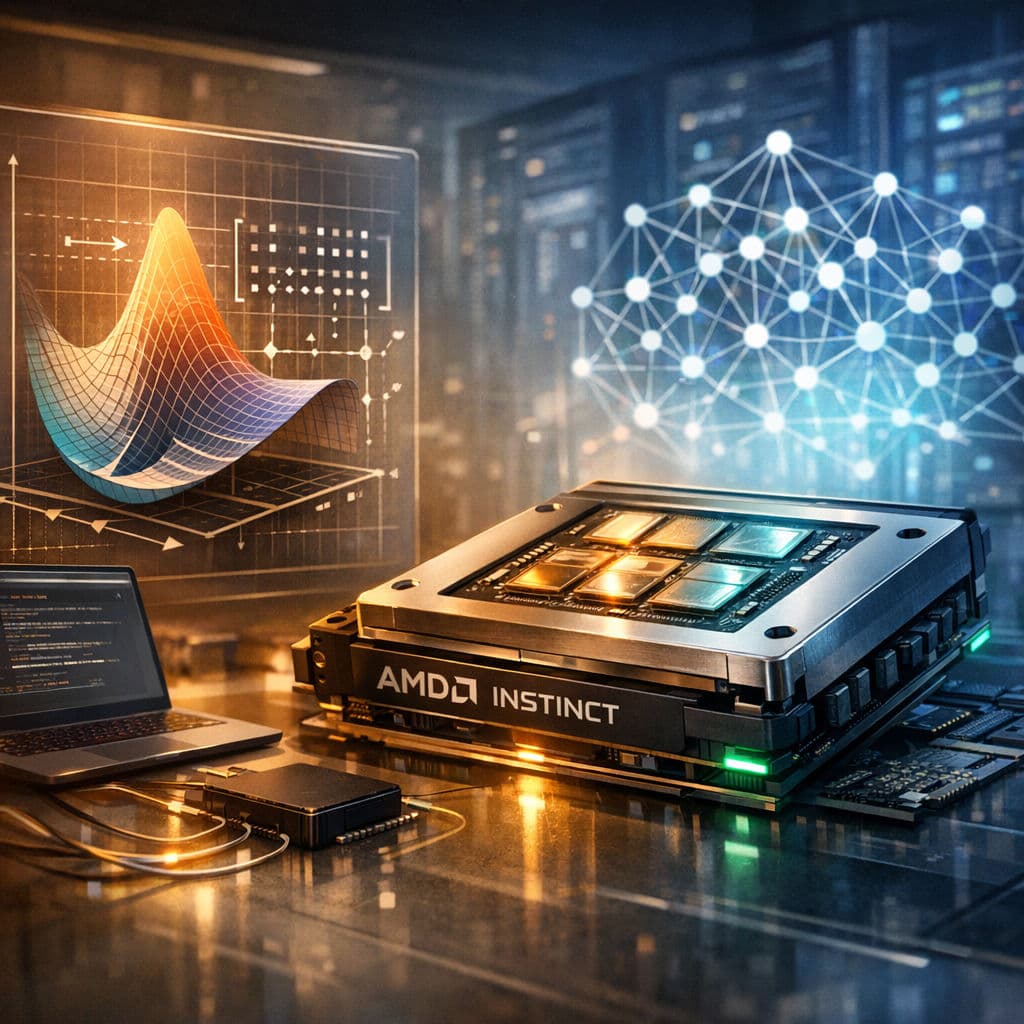
MoonMath AI has open-sourced a HIP attention kernel for AMD's MI300X, according to a June 22 report from MarkTechPost. The publication's summary says the kernel uses one-instruction assembly wrappers and an eight-wave pipeline, and that it outperforms AMD's AITER v3 on MI300X. The article's headline makes a broader claim that the kernel beats AITER v3 "on every shape and rounding mode," but the available summary does not independently enumerate or verify that full scope.
That distinction matters. In AI infrastructure, kernel-level performance claims can influence procurement, deployment strategy, and cloud economics. For leadership teams evaluating multi-vendor GPU roadmaps, the MoonMath release is notable not simply because it may improve attention throughput on AMD hardware, but because it suggests advanced optimization is increasingly coming from outside the chip vendor itself.
MoonMath, AMD MI300X, and the AITER v3 challenge
MarkTechPost reports that MoonMath AI's contribution is a HIP attention kernel designed for AMD MI300X, a flagship accelerator in AMD's data center AI stack. Attention kernels sit at the heart of modern large language model training and inference. Even small improvements at this layer can compound into meaningful gains in throughput, latency, and fleet utilization.
The technical signals disclosed in the summary are limited but important. The kernel reportedly relies on one-instruction assembly wrappers and an eight-wave pipeline. For non-technical executives, that points to a highly specialized optimization effort aimed at extracting more performance from the underlying GPU architecture rather than relying solely on higher-level framework tuning.
AMD's AITER v3 is the direct comparison point named by MarkTechPost. If MoonMath's implementation consistently exceeds the official path on MI300X, it would reinforce a broader market pattern: software optimization is becoming as strategically significant as silicon selection. That dynamic also connects to wider infrastructure efficiency trends covered in KV Cache Compression Shifts Long-Context AI Economics, where lower-level architectural changes can materially alter model-serving costs.
Why This Matters to C-Suite Executives
For C-suite leaders, this news is best understood as a control and economics story.
First, a faster attention kernel can improve return on existing GPU investments without requiring additional hardware purchases. If a company is already standardizing on MI300X systems, better kernel performance can increase effective compute capacity and reduce the cost per token or per training step.
Second, open-source optimization can change vendor leverage. If high-performance infrastructure components become available outside official vendor libraries, cloud providers, enterprise platform teams, and systems integrators gain more negotiating power. They are less dependent on a single software stack to realize hardware value.
Third, the release may reduce one barrier to broader AMD adoption. In enterprise AI, hardware purchasing decisions are often constrained not by raw chip specifications but by software maturity, operational tooling, and production confidence. An open-source ecosystem that closes performance gaps can strengthen the case for a multi-vendor accelerator strategy. That question also sits alongside infrastructure planning pressures such as power availability and scheduling flexibility, themes explored in Flexible demand examined for earlier data center grid connections.
Fourth, governance does not disappear when performance improves. Any enterprise considering production deployment of a third-party kernel will need licensing review, software supply-chain checks, provenance assessment, and long-term support planning. Those concerns fit squarely within broader Policy, Ethics & Law priorities for AI buyers.
The strategic shift: optimization power is moving outward
The MoonMath announcement points to an increasingly important industry shift: critical AI infrastructure performance is no longer controlled exclusively by chip vendors and hyperscalers. Specialist software teams, open-source developers, and independent optimization shops are starting to shape how much value enterprises can extract from expensive accelerators.
This matters because AI spending is moving from experimentation to operational discipline. Boards and CFOs are asking not just which model performs best, but which infrastructure path can deliver predictable economics at scale. In that context, low-level kernels become a business issue, not a niche engineering detail.
A similar pattern is visible across adjacent parts of the stack. New infrastructure tooling and open-source frameworks increasingly determine whether enterprises can turn hardware and model access into durable operational advantage. Readers tracking that shift may also want the broader stream in Tools & Workflows and the company-building lens in AI Business & Startups.
What is verified, and what still needs validation
There are two levels of claim in the currently available reporting.
What the available summary supports
MarkTechPost's summary supports four core points: MoonMath AI open-sourced a HIP attention kernel for AMD MI300X; the implementation uses one-instruction assembly wrappers; it uses an eight-wave pipeline; and it outperforms AMD's AITER v3 on MI300X.
What remains a stronger title-level claim
The article title goes further, stating that the kernel beats AITER v3 on every shape and rounding mode. However, the summary provided in the source material does not restate that universal scope or provide the detailed benchmark matrix needed to evaluate it independently.
For executives, that means the announcement should be treated as promising but not fully de-risked. The right next step is internal benchmarking or third-party validation across production-relevant shapes, numerical modes, reliability thresholds, and integration conditions. This is especially important in AI markets where narrative can move faster than operational proof, a broader dynamic touched on in Marketing AI Institute summary cites research on AI narrative formation.
Operational upside and execution risk
Potential upside
If the reported performance gains hold, the commercial implications could be immediate. Enterprises could improve utilization on existing MI300X fleets, reduce job completion times, and strengthen the economics of serving transformer workloads on AMD infrastructure. Cloud providers could also use such optimizations to improve margins or offer more competitive pricing for AMD-backed AI instances.
Execution risk
The same engineering decisions that enable performance can raise deployment complexity. One-instruction assembly wrappers and a hardware-specific pipeline suggest low portability and potentially higher maintenance burden. That can create talent risk if only a narrow pool of engineers can debug, adapt, and support the code under production conditions.
Platform leaders should also consider support responsibility. If an external kernel becomes central to service delivery, the enterprise may absorb more of the validation and incident-management burden unless there is a clear commercial support path. That can complicate vendor accountability and procurement frameworks.
Market implications for AMD, cloud providers, and software vendors
For AMD, a strong third-party result would be a mixed signal. On one hand, it could help the MI300X ecosystem by making the hardware more attractive to customers evaluating alternatives to NVIDIA-heavy deployments. On the other, it would increase pressure on AMD's own software stack if outside developers can outperform official libraries on headline workloads.
For cloud providers, open high-performance kernels can improve bargaining power and accelerate service differentiation. Providers may be able to tune AMD-based offerings more aggressively without waiting for vendor release cycles.
For commercial inference and optimization vendors, credible open alternatives can compress margins. Proprietary kernel performance has often been a source of differentiation. If the open-source ecosystem narrows that gap, vendors may need to compete more on integration, support, reliability, and full-stack workflow value.
For enterprise buyers, the strategic takeaway is that accelerator competition is increasingly decided by software enablement, not just hardware availability. That has implications for procurement concentration risk, especially as governments and large buyers continue to scrutinize AI access and infrastructure dependency, as seen in Macron and Modi raised AI access concerns at G7, source says.
What executives should ask next
Leadership teams considering AMD-based AI infrastructure should push for a structured review rather than a headline-driven response.
Key questions include:
- Does the reported performance advantage hold on our model shapes, sequence lengths, and rounding modes?
- What is the integration cost with our existing compiler, runtime, and observability stack?
- What open-source license governs the kernel, and what support model would apply in production?
- How much internal talent do we have for low-level GPU kernel validation and maintenance?
- Could this meaningfully improve TCO enough to alter our accelerator sourcing strategy?
That last question is central. Enterprises are already demanding better visibility into AI usage and cost controls at the application layer, as shown by OpenAI announces usage analytics and spend controls for ChatGPT Enterprise. The MoonMath development extends that discipline lower in the stack, where infrastructure efficiency often drives the largest financial outcomes.
The bottom line
MoonMath AI's open-sourced HIP attention kernel for AMD MI300X is a narrowly technical release with broad strategic implications. The verified reporting from MarkTechPost indicates performance above AMD's AITER v3 on MI300X and highlights a design built around one-instruction assembly wrappers and an eight-wave pipeline. The stronger claim that it wins on every shape and rounding mode appears in the article title and should be treated as unconfirmed until independently tested.
For executives, the larger signal is clear: AI infrastructure advantage is increasingly being created in software layers that sit below the model but above the silicon. Companies that can validate and operationalize those gains fastest may improve margins, diversify hardware exposure, and gain more control over a market still defined by supply constraints, cost pressure, and platform concentration. Related developments in optimization and deployment strategy can be followed in Models & Research and Tools & Workflows.