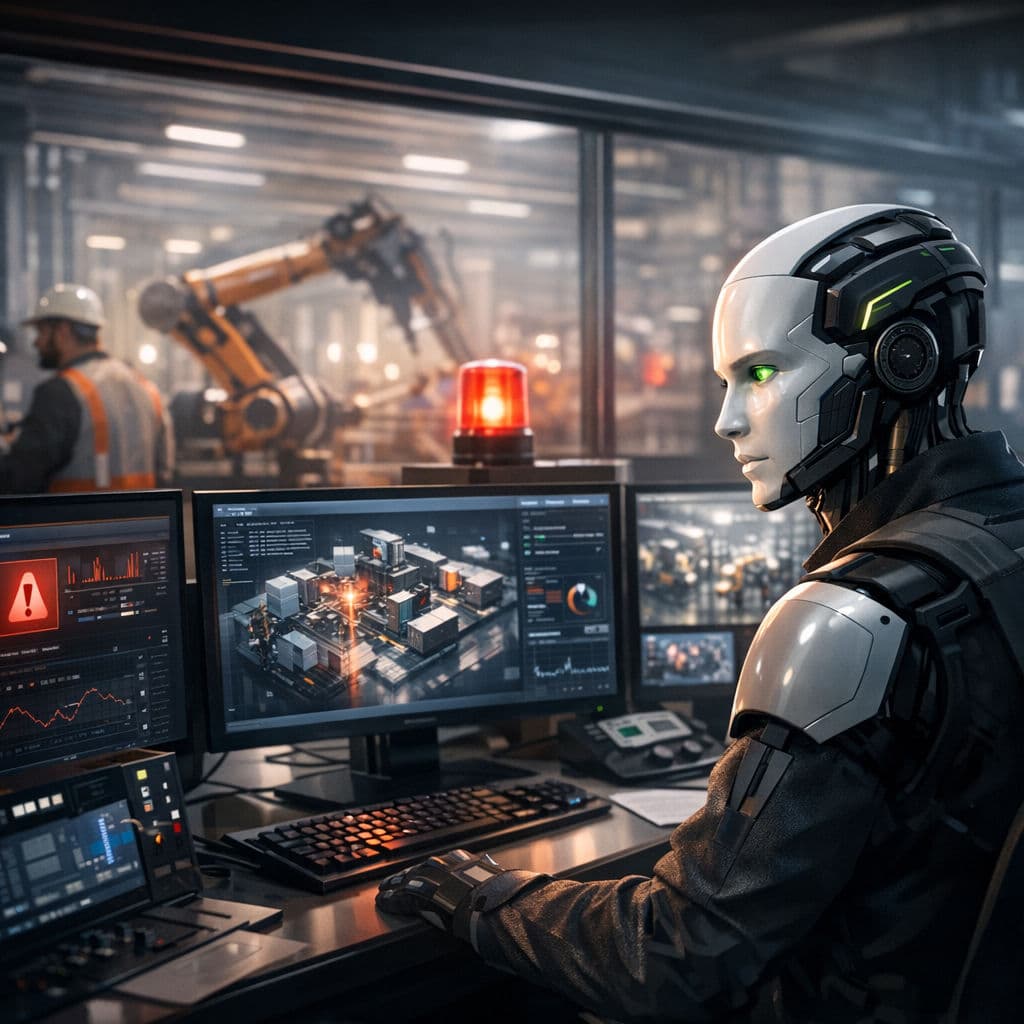
NVIDIA is moving deeper into industrial operations with a reported AI agent designed to automate factory alarm triage, a workflow that has long been constrained by operator overload, fragmented context, and the cost of downtime. According to IoT Tech News, the company has engineered a GPU-accelerated agent that analyzes alarms from SCADA and IoT systems, assembles evidence, and recommends next actions inside existing factory interfaces.
The immediate appeal is straightforward: industrial facilities can generate thousands of alarms a day, while technicians may need to inspect historical context, relevant procedures, specialist signals, and maintenance history before deciding what to do next. For enterprise buyers evaluating Enterprise AI and AI Agents, however, the larger issue is whether this becomes a reliable operational layer or remains a narrowly scoped assistant bolted onto existing systems.
NVIDIA's Reported Architecture Targets Alarm Overload
IoT Tech News reports that NVIDIA's design is built as a per-alarm analysis agent using NeMo libraries, Nemotron models, the OpenShell secure runtime, and cuVS for search across semi-structured historical data. The system is exposed behind a single HTTP endpoint and can be triggered through in-stream filters or on-click buttons within an existing user interface.
Per the report, the agent ingests an alarm payload containing sensor frames and asset metadata, then returns a structured evidence package with four elements: observation, root-cause hypothesis, remedy, and recommended action. The same report says the system uses historical remedy tickets and documented solution strategies to inform its reasoning, comparing current error signatures with past incidents before synthesizing a recommendation.
That combination matters because it positions the system less as a general chatbot and more as an operational decision service. The workflow described is tightly bounded, input-rich, and action-oriented. It also suggests NVIDIA is packaging not only inference capacity, but a stack that spans Models, retrieval, runtime security, and workflow integration.
Why This Matters to Technology decision-makers
The strongest business case is not that AI can summarize alarms faster. It is that alarm triage sits at a choke point between data collection and operational response. If an enterprise can reduce false escalation, speed root-cause isolation, and route high-confidence cases without waiting for manual first-pass review, it could lower downtime and improve technician utilization.
But technology leaders should focus on what determines production value:
1. Integration readiness
The easiest part may be exposing an endpoint in an existing interface. The harder part is ensuring SCADA outputs, IoT telemetry, asset metadata, maintenance history, and policy controls are consistent enough for an agent to use safely.
2. Knowledge quality
If historical remedy tickets are incomplete, inconsistent, or weakly labeled, recommendation quality will degrade. Retrieval-driven industrial AI is only as good as the operational memory it searches.
3. Trust and accountability
An assistant that proposes a likely remedy is one thing. A system that can influence dispatch decisions is another. Confidence thresholds, escalation logic, and auditability will matter as much as model accuracy.
4. Operating-model change
The likely labor effect is redistribution. Fewer people may spend time on repetitive alarm sorting, while more effort shifts to exception handling, policy tuning, and oversight.
The Hidden Cost Is Data and Workflow Engineering
The most important implementation detail in the report may be the least glamorous one: the agent consumes alarm payloads enriched with sensor frames and asset metadata, then checks outputs against operational policies before dispatch. That implies upstream harmonization across operational technology and enterprise systems.
In practical terms, companies considering this type of deployment will need to answer several questions before they evaluate model performance:
- Are alarm schemas consistent across plants, lines, and machine vendors?
- Can asset metadata be reliably joined to live events?
- Are maintenance tickets searchable and usable for retrieval?
- Do standard operating procedures exist in machine-readable form?
- Can escalation rules be codified into confidence and policy gates?
These are not primarily GPU questions. They are architecture, data-quality, and workflow-design questions. For many manufacturers, systems integrators and industrial software teams may capture as much value as AI infrastructure providers because they control the work needed to make these inputs usable.
Governance Becomes Central Once AI Can Route Action
The report says outputs that meet high-confidence thresholds can receive an auto-dispatch flag, while lower-confidence outputs are escalated to a human technician. That is a meaningful design choice. It shows the system is not positioned as unrestricted automation; it is framed as a policy-gated agent with a human fallback.
Even so, the governance burden rises sharply when recommendations can affect maintenance activity, uptime, and potentially safety-linked operating procedures. The broader enterprise governance challenge is echoed indirectly by a separate TechHQ report, which cites Microsoft saying 80 percent of Fortune 500 companies already use AI agents and Deloitte finding only 21 percent have a mature governance model for them. That report is not about NVIDIA's factory deployment specifically, but it reinforces a relevant market pattern: agent adoption is outpacing control frameworks.
For industrial environments, the governance checklist is likely to include model validation, evidence traceability, policy versioning, role-based approvals, and post-incident review. Those controls are what turn an interesting pilot into an acceptable production system.
NVIDIA's Broader Industrial Positioning Is Coming Into Focus
The alarm-triage report does not stand alone in showing NVIDIA's industrial ambitions. In a separate article, IoT Tech News reported on NVIDIA Halos OS, a safety-focused stack for physical AI workloads in industrial deployments. That article covers a different product area and does not independently confirm the alarm-triage system, but it does indicate that NVIDIA is building industrial credibility around safety, embedded compute, and operational deployment requirements.
Taken together, the pattern suggests NVIDIA is trying to move up the value chain: from accelerators and embedded hardware to application-adjacent operational AI. For buyers, that raises a strategic question. Is NVIDIA becoming merely the compute substrate for industrial AI, or a direct provider of higher-level decision services that could overlap with industrial AIOps, predictive maintenance, and workflow software vendors?
If the latter, platform buyers may eventually compare NVIDIA not only with chip and infrastructure suppliers, but also with vendors in industrial analytics, search, and decision automation. That has implications for procurement, architecture ownership, and vendor concentration.
Market Context: Industrial AI Meets Infrastructure Constraints
The timing is notable. Another IoT Tech News report citing Berg Insight says cellular IoT module shipments reached 612 million units in 2025, while memory pricing pressure in 2026 is being shaped by production shifts toward high-bandwidth memory for AI servers. That article does not address NVIDIA's alarm-triage agent directly, but it highlights a broader industrial reality: AI demand and industrial digitalization are increasingly linked through the same supply chains.
For technology decision-makers, that means two investment tracks may collide. On one side is the push to expand sensor-rich factory visibility. On the other is the need to finance compute-heavy AI layers on top of those systems. Enterprises that already have strong telemetry coverage and clean maintenance data may be best positioned to benefit from alarm-triage agents; those still building foundational IoT estates may face a longer path to ROI.
What Enterprises Should Verify Before Treating This as a Blueprint
The core deployment and architecture details here come from a single direct report by IoT Tech News. No other provided source independently corroborates the factory alarm-triage implementation, its production scope, or its technical specifics. That does not make the claims implausible, but it does mean buyers should separate strategic signal from verified deployment maturity.
A practical evaluation framework would include:
- Whether the agent has been deployed in live production factories or demonstrated in a reference architecture
- How confidence thresholds are set, tested, and adjusted
- Whether evidence packages are auditable enough for regulated environments
- How OpenShell, NeMo, Nemotron, and cuVS are packaged for enterprise supportability
- What level of customization is required by plant, asset class, or vendor ecosystem
For leaders tracking Developer Tools and AI Search, the architecture is still significant even if the deployment details remain lightly sourced. It shows how retrieval, policy controls, and operational context are becoming core requirements for AI agents in physical environments.
Sources and Methodology
This article was produced from a multi-source input set, but the specific claim that NVIDIA has deployed a factory alarm-triage AI agent is directly reported only by IoT Tech News. Additional context was drawn from IoT Tech News on NVIDIA Halos OS, IoT Tech News citing Berg Insight, and TechHQ on enterprise AI agent governance. Where facts were not independently corroborated across sources, they are attributed directly to the originating publication.