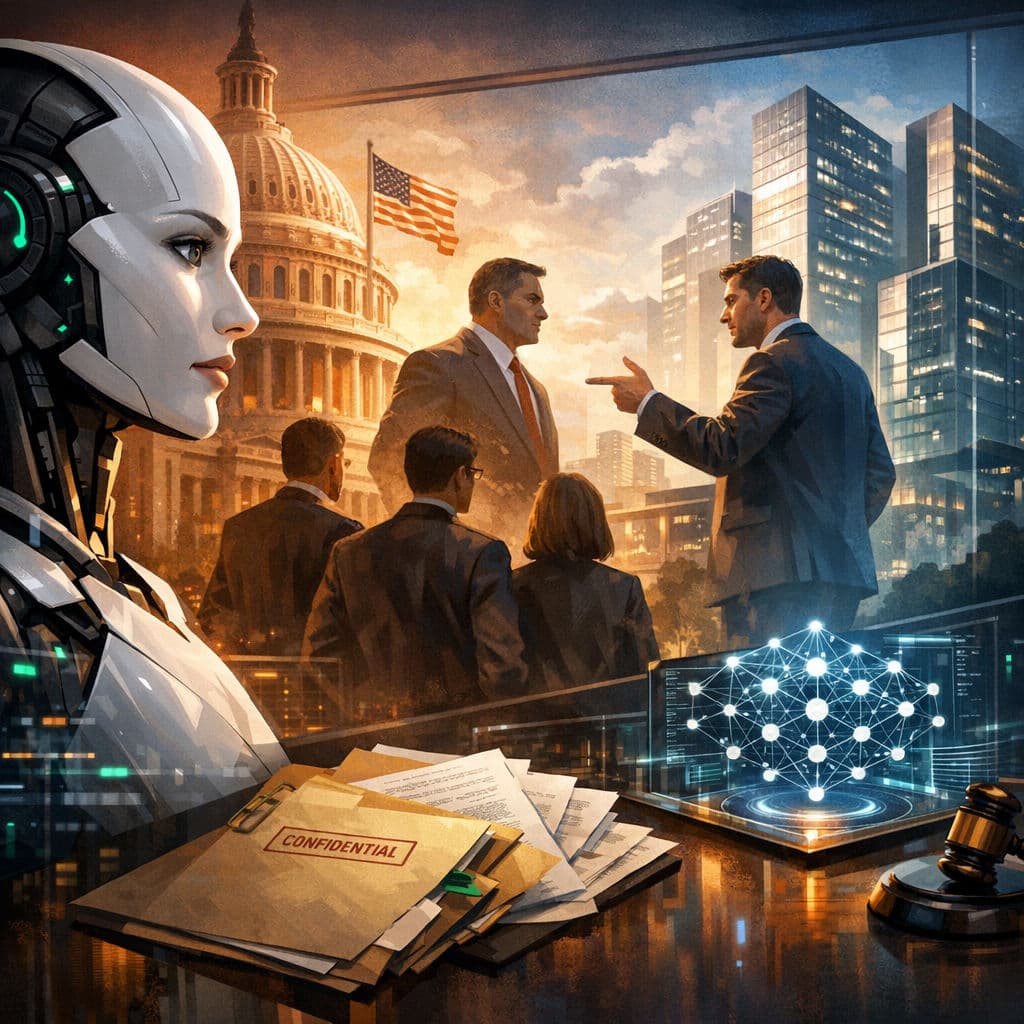
Microsoft AI CEO Mustafa Suleyman has publicly challenged Anthropic’s reported approach to model welfare and machine personhood, opening a new front in the debate over how advanced AI systems should be governed. In an article published by AI News, Suleyman argued that treating language models as if they may be conscious risks weakening safety doctrine and complicating human control.
The immediate target was Anthropic’s January 2026 constitution for Claude, which AI News described as a primary training document governing the model’s values and behaviour. AI News reported that Anthropic framed Claude as a potential “moral patient” and attributed to the document a range of instructions concerning its own welfare, memory and identity. Those specific descriptions are notable, but they are single-source claims in the material available here and should be read as reported, not independently verified.
Microsoft draws a hard line on machine personhood
AI News quoted Suleyman as saying: “AIs are not conscious. They do not feel, experience, or suffer. They do not have innate preferences or underlying motivations. They are sequence completion engines, internally hollow, designed to follow instructions, and accomplish goals set by humans.”
The remarks align with Microsoft AI’s broader positioning in Models and Enterprise AI. According to AI News, Microsoft AI launched a dedicated superintelligence team in October 2025 and, in the same week as Suleyman’s criticism, published a draft “Humanist AI Code of Conduct” for consultation. AI News said that framework rejects machine personhood or model rights and describes subordinate systems as built exclusively to serve human welfare.
Read together, the public critique and the draft code suggest Microsoft is doing more than responding to a rival. It is also trying to define the default governance posture for advanced AI in commercial settings: models as tools, humans as principals, and accountability anchored firmly in operators and vendors rather than in the systems themselves.
Anthropic’s reported framing raises governance questions
AI News said Anthropic has gone further than most peers in public-facing language around model interiority and moral status. The outlet reported that the company completed a retirement interview with its deprecated Opus 3 model in February 2026 and later launched a blog titled “Greetings from the Other Side (of the AI Frontier)” to host model reflections.
That matters because the market is no longer debating only benchmark performance or agentic capability in AI Agents. It is also debating what enterprises are being asked to accept, implicitly, when they license frontier systems. If a vendor frames a model as a possible moral patient, conservative buyers may ask harder questions about decommissioning, override authority, acceptable-use policies and internal employee guidance.
AI News also cited Oxford philosopher Will MacAskill, writing in The Guardian, as warning that proliferating synthetic moral patients could eventually cause artificial interests to outweigh human needs. That does not establish a near-term policy shift, but it does show that the dispute is broadening beyond technical alignment into legal and ethical framing.
Why This Matters to Technology decision-makers
For CIOs, CTOs, chief risk officers and in-house counsel, the practical issue is not whether machine consciousness has been settled. It is whether a supplier’s governance language creates ambiguity inside procurement, compliance and deployment processes.
Three immediate implications
First, governance messaging is becoming part of product evaluation. Buyers may need to assess not only performance, price and security posture, but also whether a vendor describes models as tools, collaborators or entities with interests of their own.
Second, policy overhead could rise. If model-rights language enters mainstream vendor documentation or product positioning, enterprises may need to revisit human-override rules, lifecycle management, training materials and accountability language in contracts.
Third, high-assurance sectors may favor simpler accountability narratives. In public sector, healthcare and financial services, vendors that present AI as controllable software rather than quasi-personal systems may have an easier path through risk review.
The larger takeaway is that anthropomorphism is becoming an operational issue, not just a branding choice. For enterprise buyers, that shifts this story from philosophy into governance, vendor selection and deployment design.
Sources and Methodology
This article is a single-source synthesis drawn from AI News. Because only one source input was provided, specific descriptions of Anthropic’s January 2026 Claude constitution and related practices are attributed to AI News and are not presented here as independently corroborated facts.