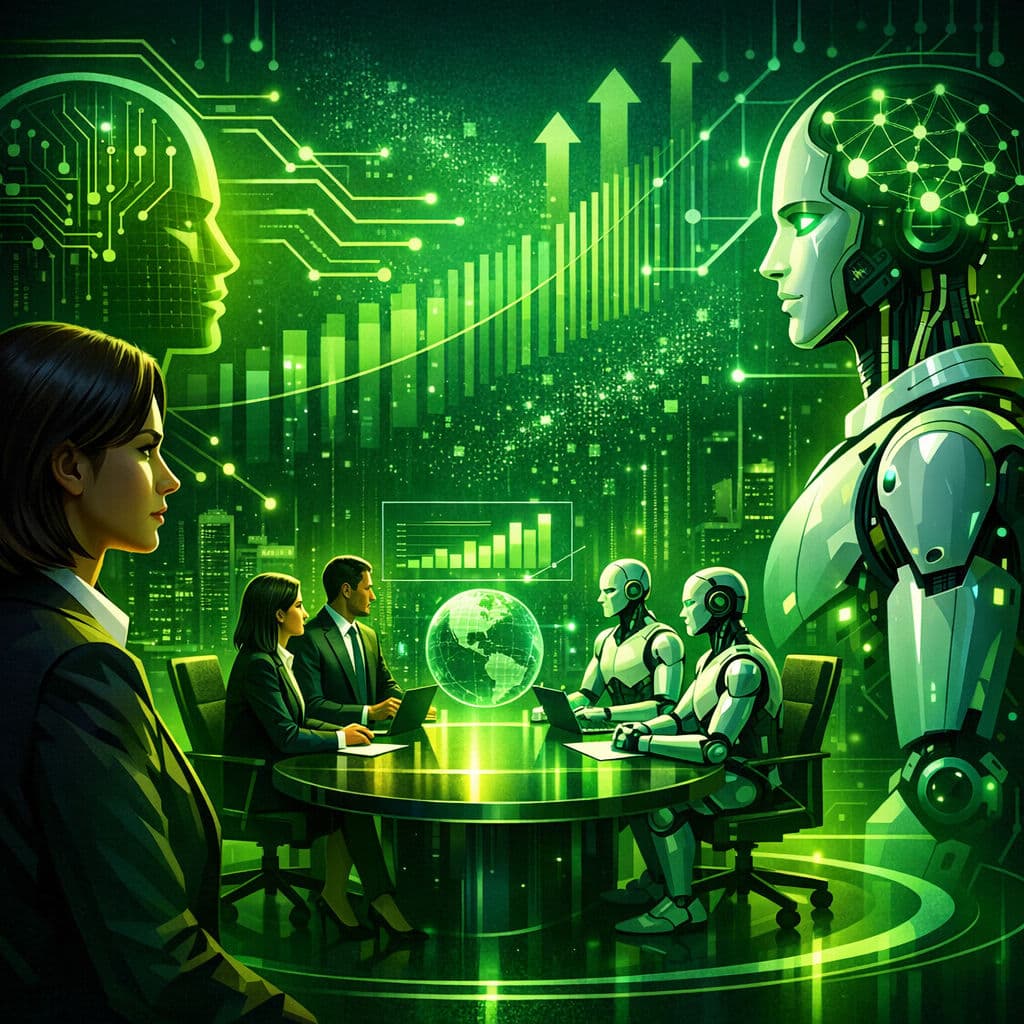
Learning to lead in a hybrid human-AI enterprise centers on how leadership teams may need to adapt if AI agent adoption increases in the next two years. According to the source summary, adoption of AI agents could rise by as much as 300% over that period, prompting closer consideration of how organizations manage a hybrid human-AI workforce.
This topic aligns with our coverage in Models & Research and relates closely to our earlier report on hybrid human-AI workforces and projected AI agent adoption growth.
The source summary describes AI agents as different from existing enterprise-level automation that relies on manual input. It says AI agents can:
- autonomously coordinate complex tasks
- interact with multiple tools and environments
- operate with less dependence on manual input than earlier enterprise automation systems
These characteristics suggest a shift from software that handles narrow, predefined steps toward systems intended to work across broader workflows.
For background on agentic system design, readers may consult OpenAI's Agents guide, Anthropic's Model Context Protocol documentation, and the research paper ReAct: Synergizing Reasoning and Acting in Language Models.
The source summary says leadership teams are considering the implications of a hybrid human-AI workforce. Based on the source notes, the management issue is not limited to software deployment. It also concerns how work is organized when some tasks are handled by people and others by AI agents.
If AI agents are used to coordinate complex tasks across multiple tools and environments, leadership teams may need to review:
- how tasks are assigned
- where human oversight remains necessary
- how responsibility is defined in mixed human-software workflows
The source summary does not provide a specific governance model or industry-by-industry breakdown. It does, however, frame the issue as a leadership and operational question rather than only a technical one.
This also connects to enterprise workflow discussions in Nextdoor's description of Codex with GPT-5.5 in engineering workflows and broader reporting in AI Business & Startups.
According to the source summary, existing enterprise automation relies on manual input, while AI agents are presented as capable of acting more autonomously. The distinction matters because enterprise workflows often span several systems rather than a single application.
If an AI agent can interact with multiple tools and environments, it may be used to continue work across those systems without requiring repeated manual initiation. The source summary presents that as a meaningful change from earlier automation approaches.
The same shift also raises practical questions. Reduced dependence on manual input may change where organizations place review steps, escalation points, and system-level controls. The source summary does not elaborate on those mechanisms, so any specific implementation details would depend on the enterprise using the technology.
The source summary states that AI agent adoption may increase by as much as 300% in the next two years. The summary does not include a baseline, methodology, or sector breakdown for that figure. As a result, the number should be understood as a source claim about expected adoption rather than a verified market outcome.
Even so, the projection helps explain why leadership teams are evaluating hybrid human-AI operating models now. If adoption does increase at that pace, organizations may face more immediate decisions about workflow design, oversight, and system integration.
Related cost and operations questions also appear in our coverage of rising AI costs and closer scrutiny of marketing workflows.
Within a Models & Research context, the source summary points to a broader analytical question: whether AI systems are moving from assisting with discrete tasks to coordinating parts of enterprise workflows more independently.
That question depends on the capabilities cited by the source summary:
- autonomous coordination of complex tasks
- interaction with multiple tools and environments
- lower reliance on manual input than existing enterprise automation
The source summary does not claim that this transition is complete. It does indicate that leadership teams are actively assessing its implications as AI agent adoption is projected to rise.
Overall, the source presents hybrid human-AI work as a management and organizational issue shaped by changes in enterprise AI capabilities.