
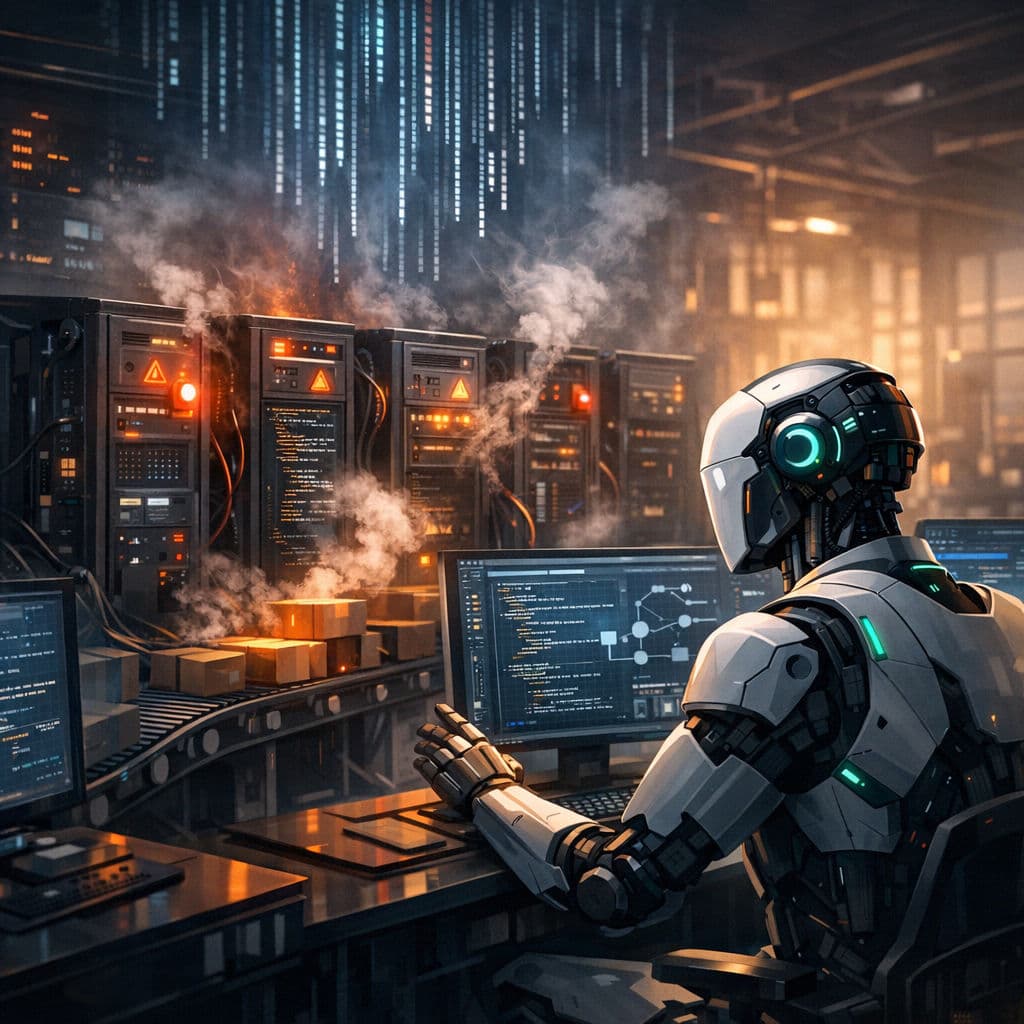
Harness is using GitHub Copilot's five-year milestone to make a broader point about enterprise software delivery: writing code faster does not automatically mean shipping software faster. In a July 1 report published by Developer Tech News, Harness Field CTO Martin Reynolds argued that AI code generation is exposing structural limits in legacy CI/CD pipelines, especially where companies have increased developer output without redesigning testing, release, and governance workflows.
For technology decision-makers, that reframes the economics of Developer Tools and Enterprise AI. The question is no longer whether coding assistants can produce more code. It is whether the rest of the software delivery system can absorb that output without longer queues, higher cloud costs, slower security feedback, and weaker release reliability.
Harness puts the bottleneck after code generation
According to the Developer Tech News report, Harness says organizations are boosting developer throughput with AI assistants while still routing those changes through static or manual CI/CD environments. Reynolds' central claim is that this mismatch is now visible at scale: code generation has accelerated, but delivery infrastructure has not.
The article attributes several operational effects to that mismatch. Harness says AI-generated boilerplate and other routine changes can drive sharp growth in pull-request volume. Legacy delivery systems, according to the company, answer by queuing builds, consuming more cloud compute, and failing to complete security scans within acceptable timeframes. The same report says production data from enterprise implementations shows a correlation between high Copilot adoption and failing build pipelines.
That correlation should be handled carefully. It is a vendor-attributed claim reported by Developer Tech News, not an independently verified cross-market benchmark. Still, even as a single-source warning, it points technology leaders toward a practical issue: if the unit of work rises sharply, every downstream system gets stress-tested.
Why This Matters to Technology decision-makers
Many AI coding business cases still focus on developer seat costs and raw productivity uplift. Harness' argument suggests that approach is incomplete. If a coding assistant doubles code-change volume but the validation path remains fixed, the enterprise may simply relocate the bottleneck from authoring to review, testing, scanning, and deployment.
That has budget and governance implications across platform engineering, QA, release engineering, DevSecOps, and FinOps. More builds can mean more ephemeral compute. More pull requests can mean noisier code review. More queued scans can weaken software assurance timelines. In regulated environments, delayed security verification can also create audit friction, even if the source material stops short of proving specific compliance outcomes.
In practical terms, AI coding ROI may depend less on the quality of the model and more on end-to-end throughput. Enterprises that treat coding assistants as isolated productivity purchases risk underestimating the work needed across pipelines, policy automation, test selection, artifact management, and deployment controls.
Human-paced SDLC assumptions are colliding with machine-paced output
One of the most important details in the Harness framing is the baseline it challenges. The report says traditional SDLC assumptions were built around developers making a small number of substantial pull requests each day. AI assistance changes that rhythm by making it easier to generate many more code changes, especially for boilerplate, repetitive tasks, and incremental updates.
That shift matters because most enterprise delivery tooling was tuned for a human cadence. Build agents, test suites, review workflows, and security scanners were often provisioned around predictable commit behavior. Once AI increases the number of candidate changes, throughput becomes the central engineering problem.
The result is a familiar systems pattern: local optimization creates global congestion. Teams may see faster code creation at the keyboard while waiting longer for trustworthy feedback from the pipeline. For CIOs and CTOs, that means software delivery metrics need to move beyond developer productivity alone and include queue time, build failure rates, scan completion latency, and cloud cost per validated change.
Other enterprise AI deployments point to the same design lesson
Although the source bundle does not independently validate Harness' pipeline claims, two other July reports reinforce the same broader principle: AI works better when the surrounding system is redesigned instead of simply overlaid onto legacy processes.
In a separate report, AI News covered AWS and Bluesight's work on Prism, an AI layer for hospital pharmacy and 340B compliance workflows. A key architectural choice was to avoid direct database access by the model. Instead, Bluesight exposed existing application logic through APIs and MCP-compatible tools, with the agent selecting and calling structured functions. That matters here because it shows an enterprise pattern: keep business logic and controls in the application layer, and adapt the AI interface to the system rather than bypassing the system.
The same systems view appears in infrastructure governance. Another July report from AI News on Cloudflare's new controls for AI agent crawlers shows how assumptions that once held for the open web are being replaced by explicit permissions, traffic classes, and policy boundaries. For enterprise buyers of AI Agents, the lesson is similar: scaling AI is increasingly about operational architecture and control surfaces, not just model access.
These examples come from different domains, but they support the same executive reading of the Harness argument. AI adoption is maturing from a feature decision into an infrastructure decision.
What leaders should audit before expanding AI coding
1. Pipeline elasticity
Assess whether CI/CD capacity can scale with sudden growth in pull-request volume. Static build pools and monolithic test stages are likely to show strain first.
2. Test selection and continuous testing design
Harness argues that generative coding requires a rebuilt or materially changed approach to continuous testing. Leaders should examine whether full-suite execution is still economically defensible for every AI-assisted change.
3. Security scan latency
If scan queues lengthen, risk does not necessarily rise immediately, but confidence in release timing can fall. Track completion windows and exceptions closely.
4. Cloud cost per validated change
More code suggestions can inflate build and test activity faster than expected. FinOps teams should measure whether AI-assisted throughput is creating waste or net delivery gains.
5. Governance and review quality
Higher code volume can blur accountability if review policies remain unchanged. This is particularly relevant for enterprises standardizing on Models and assistants across multiple teams.
Market implications for vendors and internal platform teams
If Harness is directionally right, the near-term winners are unlikely to be coding assistants alone. The stronger position may belong to vendors and internal teams that improve throughput after code is generated: CI orchestration, adaptive testing, policy automation, security tooling, and release management.
The likely losers are organizations still dependent on static or heavily manual delivery paths. In those environments, AI-assisted output can magnify existing inefficiencies rather than remove them. That does not mean coding assistants fail. It means the value capture moves to whichever layer clears the bottleneck.
For enterprise buyers, this also changes procurement logic. AI coding tools should be evaluated with platform engineering readiness assessments, not as standalone productivity subscriptions. The more aggressive the rollout, the more important it becomes to measure system resilience as a first-class KPI.
The strategic takeaway: optimize software throughput, not just code output
The most durable insight in the Harness report is that AI coding shifts software delivery from a developer-productivity conversation to a throughput-management conversation. Faster generation creates pressure on every validation and release mechanism downstream. If those systems remain human-paced, the organization can experience more noise, more delay, and more cost even as code arrives faster.
That is why the reported correlation between Copilot adoption and pipeline failures matters even without independent corroboration. It identifies where leaders should look first. The immediate management task is not choosing between optimism and skepticism on AI coding. It is instrumenting the delivery chain well enough to tell whether AI is accelerating the business or merely accelerating backlog inside the pipeline.
Sources and Methodology
This article was produced in multi-source mode, but the central operational claims about CI/CD bottlenecks, pull-request volume, and reported correlation with build failures come from a single vendor-attributed report published by Developer Tech News citing Harness and Martin Reynolds. Additional context on enterprise AI system design and control frameworks was drawn from AI News on AWS and Bluesight and AI News on Cloudflare's AI agent crawler rules. No unsupported claims were treated as independently verified market facts.