
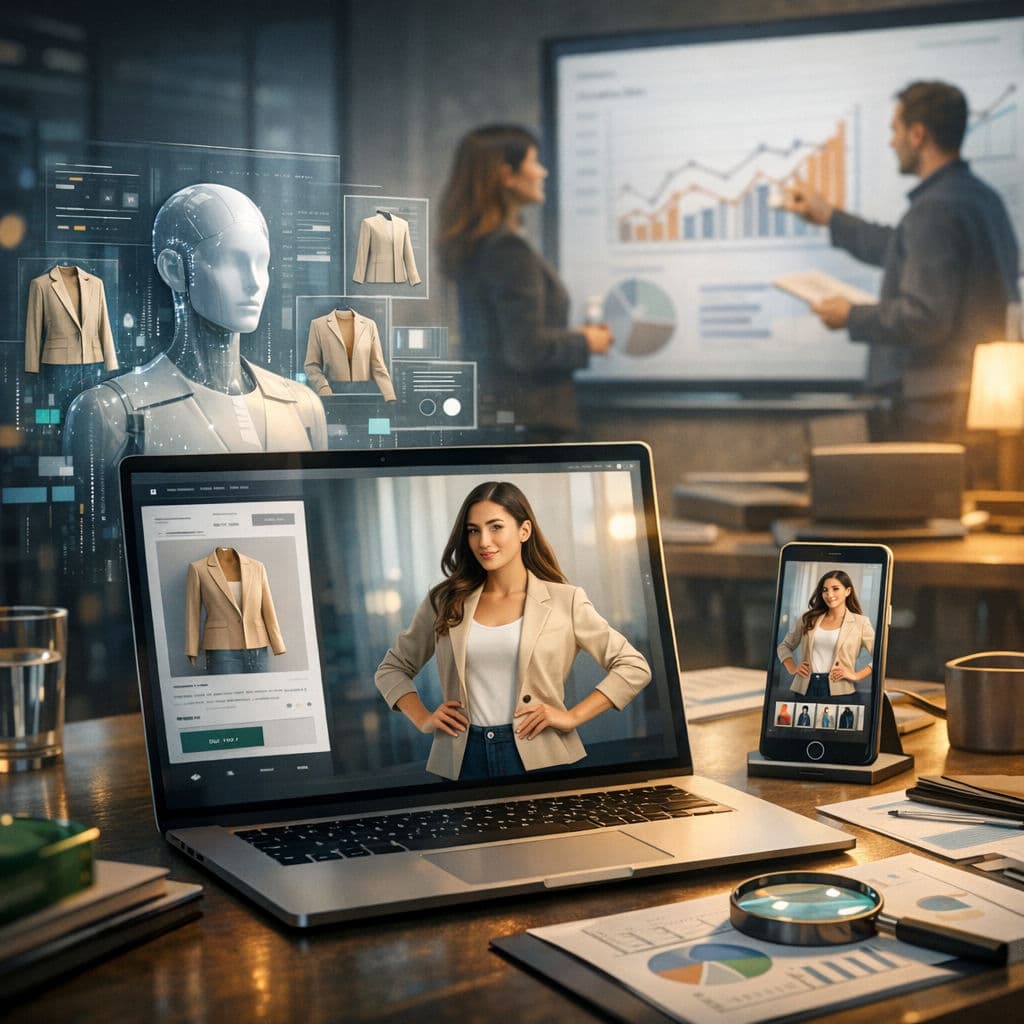
DRESSX reports a measurable conversion gap between try-on users and non-users
A 2026 DRESSX analysis, reported by Marketing Tech News, examined whether AI-powered virtual try-on is associated with stronger ecommerce performance in fashion and luxury retail. The dataset covered 1.2 million shoppers across 216 countries and 83 languages and compared users of DRESSX AI Try-On with shoppers who did not use the feature.
The headline numbers are notable. One reported result says try-on users converted from product view to cart at about 11%, versus 4% for non-users. Another result, presented as a luxury ecommerce segment cut, says try-on users recorded 10% view-to-cart conversion versus 2% for shoppers who did not use try-on. On purchase conversion, the report says view-to-purchase conversion was 3% for try-on users versus 2% for non-users, framed as a 50% higher purchase conversion rate.
Those figures land in a category where online performance remains structurally weak. The same report, as cited by Marketing Tech News, places average ecommerce conversion at 1.65%, fashion ecommerce conversion at roughly 1% to 2%, and physical retail conversion at 23% to 30%. It also cites online apparel return rates of 30% to 40%.
Why fashion ecommerce is focusing on fit, fabric, and silhouette
DRESSX argues that static product imagery leaves material gaps in the buying decision, especially around fit, silhouette, fabric behavior, and styling. That matters in apparel because the product cannot be fully evaluated from standard model photography, videos, or size charts alone. In-store retail has long benefited from fitting rooms; AI try-on is being positioned as a digital approximation of that confidence layer.
According to the report summary, DRESSX's system uses silhouette mapping, fabric modelling, and generative AI to render garments on shoppers. The article also says the study included luxury fashion ecommerce platforms such as Victoria Beckham, Loulou de Saison, TTSWTR, and Pascal.
For readers tracking adjacent AI commerce trends, this sits naturally alongside broader coverage in Enterprise AI and Models, where technical capability is starting to affect front-end revenue metrics rather than only back-office productivity.
Why This Matters to Technology decision-makers
For CIOs, CTOs, chief digital officers, and ecommerce platform leaders, the immediate significance is not that AI try-on has been conclusively proven to lift sales. It has not. The more important signal is that interactive AI layers are increasingly being tied to commercial metrics in categories where conventional digital merchandising underperforms.
That creates a practical architecture question: should AI try-on be treated as a merchandising feature, a conversion optimization system, or a core customer experience capability? The answer affects budget ownership, experimentation design, data governance, and vendor evaluation.
It also changes the shape of ecommerce infrastructure. A retailer deploying try-on at scale may need more than a front-end widget. Likely requirements include structured garment data, product image pipeline changes, rendering performance optimization, analytics instrumentation, mobile UX tuning, and integration with experimentation and attribution systems. Teams already evaluating AI-infused shopping interfaces may also want to monitor adjacent developments in AI Search, where AI assistants are beginning to influence how shoppers arrive at product pages in the first place.
The evidence is promising, but still correlational
The most important caveat is methodological. Marketing Tech News attributes the performance claims to DRESSX and notes that DRESSX characterizes the findings as directional and correlational rather than causal. That distinction matters. Users who choose to engage with try-on may already be more purchase-intent shoppers than those who do not.
The supplied source set also includes a discrepancy in the reported cart-conversion figures: one data cut cites 11% versus 4%, while a luxury-segment result cites 10% versus 2%. These should not be collapsed into one headline number. They appear to reflect different slices of the dataset, but the published summary does not provide enough methodological detail to reconcile them fully.
For decision-makers, that means the right interpretation is “associated with higher conversion,” not “caused higher conversion.” A controlled pilot with holdout groups remains the strongest next step before broad deployment.
AI try-on is part of a wider AI commerce shift
The try-on story is not standing alone. In a separate report, Marketing Tech News cited Adobe Analytics data showing that AI-referred retail traffic rose 138% year over year in May 2026. According to Adobe, those visitors converted at a 54% higher rate than non-AI traffic and generated 53% more revenue per visit.
The same report says Shopify also reported stronger performance from AI-referred shoppers, with conversion nearly 50% higher than organic search visitors and average order values 14% higher. More than half of AI-referred sessions reportedly started on product detail pages, compared with about 20% for organic search.
Taken together, the pattern is becoming clearer: AI is moving from support tooling into live commerce pathways. Discovery is changing through AI referrals, and evaluation is changing through tools such as virtual try-on. That shift has implications for attribution, merchandising strategy, and platform roadmaps.
The hidden implementation work sits behind the interface
Virtual try-on may look like a customer-facing feature, but most of the hard work sits underneath it. Retailers need consistent garment metadata, image quality control, SKU-level asset governance, and rendering systems that work across body types, skin tones, genders, and aesthetics. The DRESSX article itself highlights product detail, fabric behavior, and broad representation as requirements for luxury-grade try-on tools.
That creates a familiar enterprise pattern. The visible AI experience depends on less visible operational maturity. Teams that already struggle with fragmented workflows may find that rollout slows unless ownership is clear across ecommerce, data, legal, merchandising, and engineering. This is where adjacent platform disciplines, including Developer Tools, become relevant, especially for testing, observability, and integration reliability.
A further issue is governance. Any system that renders garments on shopper images can trigger legal and security review, particularly if images are uploaded, stored, or processed across jurisdictions. The supplied sources do not detail these controls, so this remains an implementation inference rather than a reported fact, but it is likely to become a material gating factor in enterprise rollouts.
What technology leaders should measure next
Given the current evidence, the strongest course is disciplined testing. Retailers should separate three questions that are often conflated.
1. Does try-on lift conversion?
Measure product-view-to-cart and product-view-to-purchase performance with holdout groups and segment by category, traffic source, device type, and geography.
2. Does it reduce returns?
This is commercially critical in apparel, but the supplied DRESSX summary does not demonstrate it. Return-rate effects should be measured independently from conversion.
3. Is the economics case durable?
Technology teams should model gross-margin impact after accounting for integration work, model quality tuning, latency, content operations, and governance overhead.
The strongest adoption case may be luxury and higher-consideration fashion, where styling uncertainty is expensive and the reported conversion gap appears wider. But even there, single-vendor directional evidence is not a substitute for internal experimentation.
Sources and Methodology
This article uses a multi-source input set, but the core claim linking AI try-on to higher ecommerce conversion is effectively single-source within that set. The principal evidence comes from Marketing Tech News' report on the 2026 DRESSX analysis. Broader market context on AI-assisted commerce performance comes from Marketing Tech News' separate report citing Adobe Analytics and Shopify. An additional supplied article on drug discovery was not used because it was unrelated to ecommerce conversion. The analysis above distinguishes reported facts from derived implications and treats vendor-reported results as correlational unless independently validated.