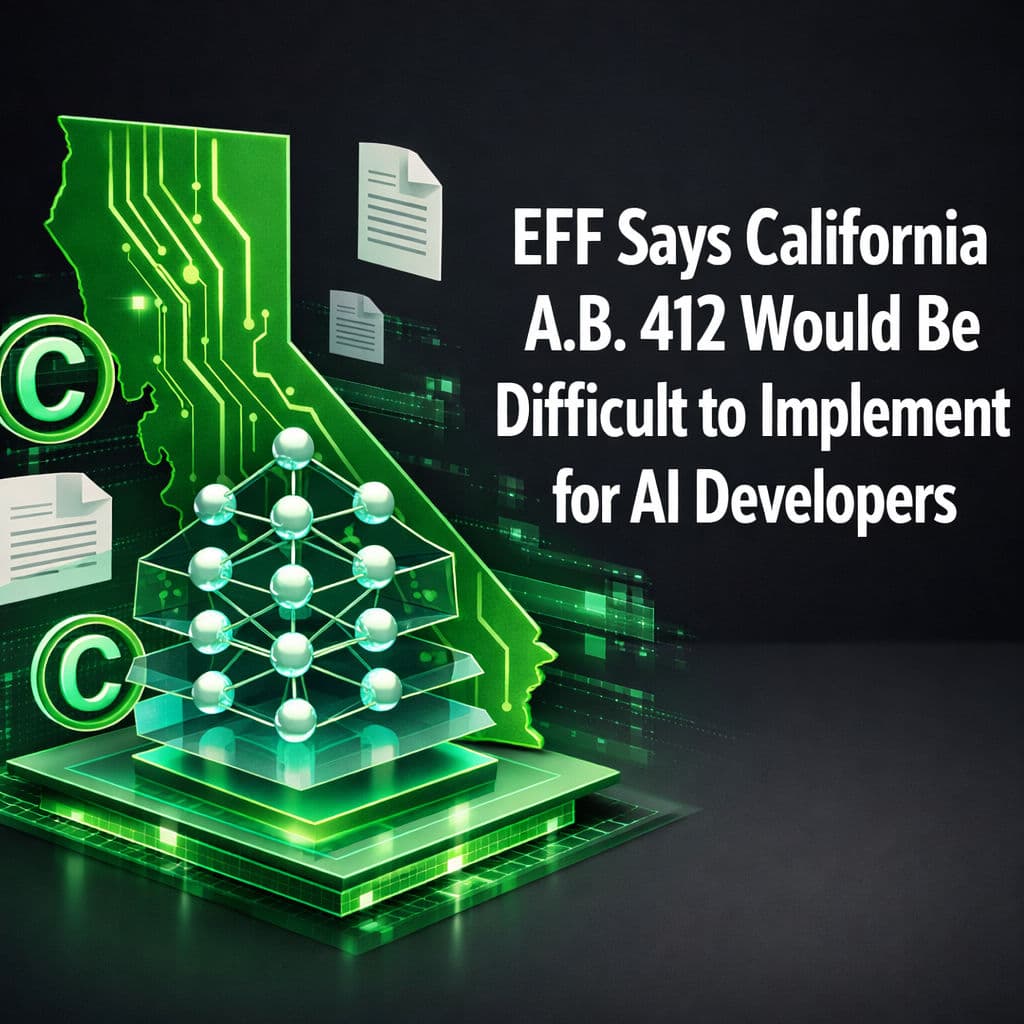
California lawmakers are again considering A.B. 412, a proposal that would require AI developers to identify and disclose copyrighted works used to train generative AI systems. Digital rights advocates say the measure would be difficult to carry out and could favor larger technology companies.
The Electronic Frontier Foundation (EFF), in an opposition letter filed with the California Senate Privacy Committee in May 2026, said the bill “is simply unworkable” and would impose “a costly and essentially impossible compliance burden” on developers. The organization also said the measure could “lock in the power of the largest companies in AI” by making compliance easier for firms with legal and technical staff than for smaller competitors.
A.B. 412 would require AI developers to keep track of registered copyrighted works used in training generative AI systems and disclose that information. The Electronic Frontier Foundation said the bill’s premise is that copyright owners lack meaningful remedies when they believe their works have been misused by AI companies, but argued that existing federal law already gives rights holders tools to bring claims.
The group said those issues are already being addressed in federal court, where judges are considering fair use and transformative use questions in AI training cases. The EFF said some courts have concluded that “many AI training activities qualify as fair use.” For background on how AI systems are typically trained, see this overview from Stanford HAI.
A central objection in the EFF letter is that the bill would require developers to match large data sets against copyright records that are incomplete, fragmented or not easily searchable in the ways the legislation would require.
The group said there is no machine-readable “list” of copyrighted works at the U.S. Copyright Office, making it difficult to identify all registered works in a way that can be automated. It also said some copyright registrations do not include a publicly viewable sample of the work, which can make verification harder. The U.S. Copyright Office explains its registration process and public records access on its website.
The EFF gave examples of how copyright status can vary across the internet. One image may be registered with the Copyright Office, while another may be covered by a free Creative Commons license, and another may be in the public domain. In other cases, a user may post an original story, photograph or poem online without indicating whether the work is registered or who owns it.
In the group’s view, A.B. 412 would require developers to continually cross-reference online content against copyright records, a process it said the copyright system was not designed to support.
The EFF said the bill would extend beyond major AI laboratories and could affect a broader range of developers than its supporters may intend.
Under the measure, the definition of “developer” would apply to “anyone” who makes a generative AI model available to Californians. The group said that could include independent developers working with existing models, open-source projects, nonprofit groups and other non-commercial efforts.
Recent amendments added exemptions for universities and government entities. Even so, the EFF argued that many non-commercial actors would still be covered, including people working outside institutional settings.
The EFF said large companies would likely respond by hiring compliance teams and lawyers, while smaller organizations and independent developers would often lack the resources to do the same. That difference, it said, could discourage some smaller developers from building or releasing products.
The debate over A.B. 412 is unfolding while federal courts continue to examine how copyright law applies to generative AI training.
The EFF said courts are already deciding whether some AI training uses qualify as fair use and how transformative use should be analyzed. It said the legal landscape remains unsettled, with different courts taking different approaches.
According to the group, California should not move ahead with its own regulation while those issues remain unresolved at the federal level. It argued that copyright is governed nationally and that existing federal law already gives rights holders ways to protect their interests.
California continues to be a major state in debates over technology regulation, copyright and digital rights. In the case of A.B. 412, lawmakers are weighing the interests of copyright holders against the compliance demands the bill would place on AI developers.
The EFF said the bill would not add meaningful clarity or transparency, but instead would create a reporting burden that could be difficult for smaller developers and researchers to meet.
Readers can also see Mira Murati Discusses Visibility in the AI Sector for more context on how AI companies and leaders are navigating public scrutiny and industry visibility.
The group said California residents who want to contact their legislators about the measure can do so “through this website.”
As the discussion continues, the bill remains under scrutiny from digital rights advocates who say the state should be cautious about imposing new requirements while federal courts continue to define the legal boundaries of AI training and copyright use.